
NextSense Does More Than Watch You Sleep. It Tries to Change It
Sleep trackers have made it easy to count hours. They have done far less to explain why two nights of identical length can feel completely different. A device worn on the wrist can infer sleep stages from movement and heart rate, but it has no direct view of what the brain is actually doing while a person rests. For anyone who wakes up having logged a full eight hours and still feels foggy, that gap between what gets measured and what actually matters has become one of the most frustrating problems in personal health technology.
Jonathan "JB" Berent is the Founder and CEO of NextSense, a company building brain-sensing earbuds designed to close that gap. Before founding NextSense in 2020, Berent spent years at Google, eventually becoming a director at X, the company's research lab for long-range projects. He studied philosophy and religious studies at Stanford, not neuroscience, and traces the company's origin to a personal experiment: reworking his own sleep schedule around a method called polyphasic sleep, which breaks rest into shorter, scheduled blocks instead of one long stretch.
In this episode of Lead with AI, Dr. Tamara Nall speaks with JB about how NextSense turns raw brainwave data into a real picture of sleep quality, how the earbuds use sound to shape that picture as it happens, and what he thinks brain-sensing technology could do beyond sleep.
A Philosophy Major Chasing a Neuroscience Problem
JB describes himself as curious by nature, someone who got restless enough with his own career to reinvent it. About ten years ago, he met a Google colleague who practiced polyphasic sleep, splitting rest into several shorter blocks across the day instead of one long night. The idea that a sleep schedule could hand someone back real hours and real energy stuck with him. It took years to work out a schedule that actually functioned, and once it did, JB started asking a different question: could technology make that kind of change accessible to people who did not want to spend years experimenting on themselves.
That question became NextSense, built originally as a research project inside X, Google's lab for long-range technology. JB pitched the idea after a mentor shared research showing that slow-wave sleep, the deepest and most restorative stage, could be extended through sound. Google funded an initial study with Northwestern University. According to JB, the results showed a 10 to 15 percent improvement in memory test scores among people who received the sound stimulation, compared to those who did not.
What Is a Slow Wave, and Why Does It Matter?
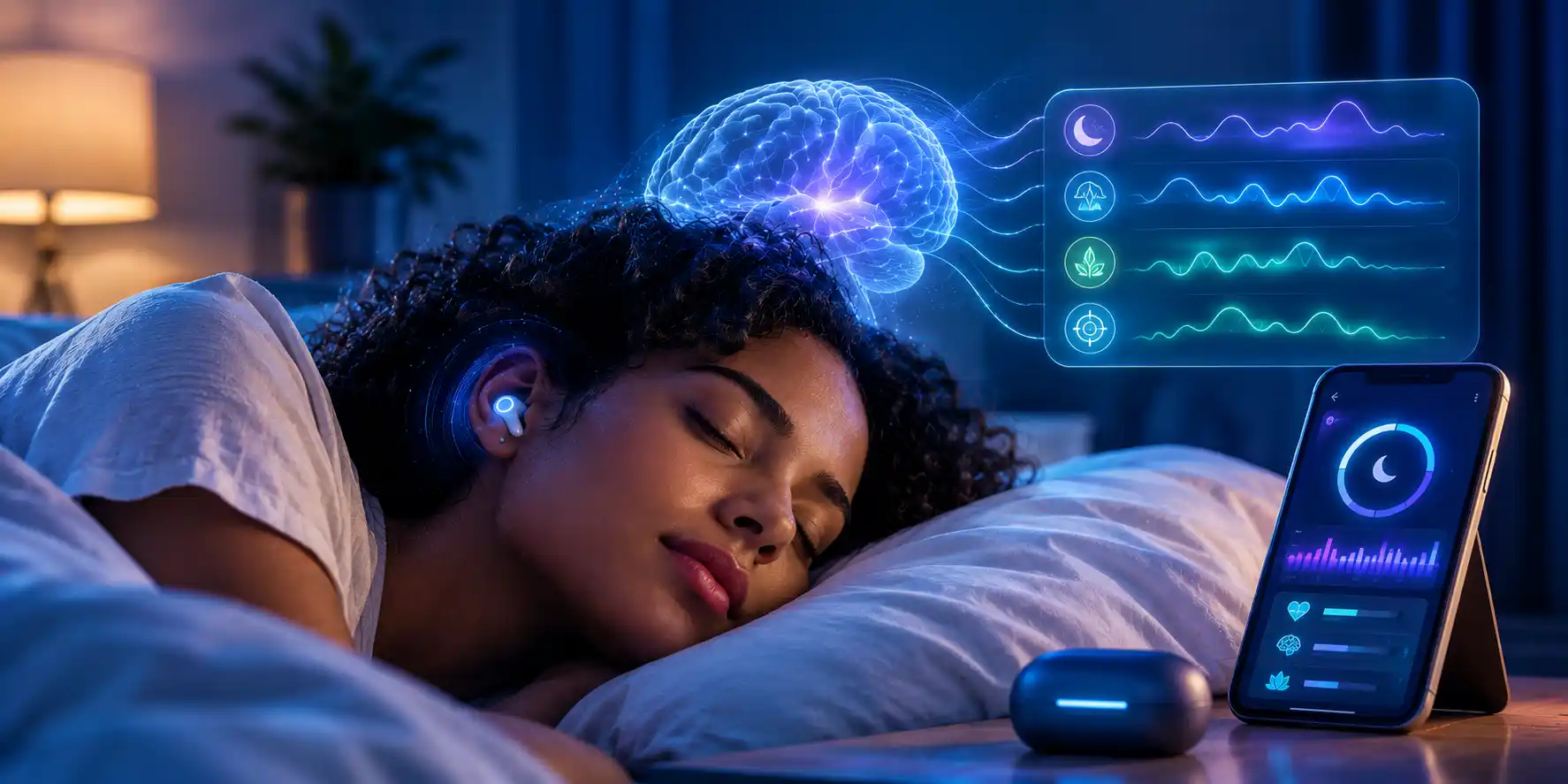
Brain activity during sleep is loud and disorganized on its own. NextSense's earbuds sense that activity through EEG, then sort it into frequency bands, slow delta waves, faster beta waves, and several bands in between, each associated with a different mental state. Delta waves show up during deep, restorative sleep. Alpha and theta waves show up during states linked to focus and creativity.
Once the system knows what state a brain is in, it can respond. NextSense uses pink noise, a sound frequency weighted toward lower tones, timed to specific moments in a sleep cycle to help extend slow-wave activity. JB compares the underlying idea to Fitbit popularizing the 10,000-step goal: once people could see their own slow-wave count, he expects some will start chasing a nightly target the same way they chase step counts today, adjusting habits like alcohol or screen time to see what moves the number.
Teaching the Brain Where It Wants to Go
The earbuds do more than observe. Through the NextSense app, a user can choose a mode, sleep, focus, or meditation, and the system responds with sound designed to help guide the brain toward that state. JB acknowledges that this happens through a button press today, not a thought read directly from the brain. The company is not there yet, and he does not oversell it as if it were.
He is not a terrible sleeper himself. He simply wanted more.
The Investor Who Could Not Sleep, and the CEO Who Heard About It
One of NextSense's early users, an investor JB refers to as Lisa, was going through menopause and could not sleep more than a couple of hours at a stretch. She tried the first-generation earbuds, worked through some early comfort issues with JB directly, and within weeks was sleeping six and seven hours a night. She ended up investing in the company.
Another user, whom JB calls Steve, became an active presence in NextSense's customer community, helping other users troubleshoot the product. Steve liked the earbuds enough to pass them along to his own boss, who turned out to be the CEO of one of the world's largest consulting firms, a company managing more than 100,000 employees. That CEO spent half an hour with JB discussing the product.
That is the kind of word of mouth no marketing budget can buy.
Brain Data That Never Has to Leave Your Phone
JB is direct about where NextSense draws its ethical lines. The company built its algorithms to run locally on a user's phone, so brain data does not have to reach the cloud unless someone opts in to share it for the sake of improving the model. He traces this decision to disagreements he had with Google over who actually controls user data, and says it is part of why NextSense had to exist as its own company rather than a Google product.
NextSense also does not run on an advertising model and says it does not sell user data. JB points to ongoing research into using sound to influence dreams as a reason the guardrails matter now, before the underlying technology gets more capable. The company publishes a neuroethics policy and gives users the ability to delete their data.
Smart Socks and Shirts Are Already in the Works
JB's longer-term vision for NextSense goes past earbuds. He describes wanting the company to become what he calls the Apple of human health, expanding brain and body sensing into other wearable forms. NextSense already holds patents covering smart shirts and socks, and the team is pursuing a grant through ARPA-H to extend sensing into cardiovascular and metabolic signals alongside sleep.
He also points to earlier research from his time at X into silent speech interfaces, the idea that people could interact with AI through subtle, largely invisible signals rather than typing or speaking aloud. Whether that ends up inside a future NextSense product or somewhere else entirely, JB sees it as part of the same underlying direction: less friction between a person's biology and the technology meant to support it.
Quick Answers
What is NextSense? NextSense is a brain-sensing earbud platform built by Jonathan "JB" Berent that uses EEG sensors to read brainwaves and delivers targeted sound to help people understand and improve their sleep and focus.
How does NextSense help with sleep? The earbuds sense brain activity and sort it into frequency bands linked to different mental states. During sleep, the system can respond to slow, restorative brain waves with timed sound designed to help extend that stage of rest.
Does NextSense send brain data to the cloud? No, by design. NextSense's algorithms are built to run locally on a user's phone. People can choose to share data if they want the algorithms to improve, but it is optional, not required.
Can NextSense help with focus, not just sleep? Yes. Alongside sleep mode, the app includes a focus mode and a meditation mode that use the same brain-sensing and sound-based approach to support different mental states.
Who is JB Berent? Jonathan "JB" Berent is the Founder and CEO of NextSense. He previously worked at Google, including as a director at X, the company's long-range research lab, before leaving to build NextSense.
For anyone curious about what brain data looks like when it is finally visible instead of guessed at, this conversation lays out where that technology stands today. NextSense is live now at nextsense.io.
Get 20% off: Lead_with_AI_20
For more conversations with the founders building the next generation of AI, subscribe to Lead with AI on your favorite podcast platform.
Follow or Subscribe to Lead with AI Podcast on your favorite platforms: Website: LeadwithAIPodcast.com | Apple Podcasts: Lead-with-AI | Spotify: Lead with AI | YouTube: @LeadwithAIPodcast | Facebook: Lead with AI | Instagram: @LeadwithAIpodcast | TikTok: @LeadwithAIpodcast | Twitter (X): @LeadwithAI
Follow Dr. Tamara Nall: LinkedIn: @TamaraNall | Website: TamaraNall.com | Email: Tamara@LeadwithAIPodcast.com
Follow JB Berent (Founder & CEO, NextSense): Website: nextsense.io | LinkedIn: @jonathan-berent
Comments